

In today’s mobile industry, businesses constantly seek innovative strategies to stay ahead. The choice between nearshoring and offshoring has become pivotal for many companies looking to optimize their operations in 2024.
This blog explores the nuanced distinctions and evolving dynamics of nearshore versus offshore approaches in the mobile sector. We will discuss how each outsourcing model impacts mobile industry players’ agility, cost-effectiveness, and overall success in a rapidly evolving technological and globally competitive landscape. It is crucial to understand these models to make informed and strategic decisions.
Understanding Nearshore and Offshore: A Quick Overview
In the I.T. industry landscape, particularly within the mobile sector, the terms ‘offshore’ and ‘nearshore’ outsourcing have become integral to business strategy discussions. We must grasp these concepts to make informed decisions aligned with your company’s objectives and operational dynamics.
Offshore Outsourcing
Offshore outsourcing occurs when a company delegates its development or operational tasks to a partner in a significantly different time zone. This approach primarily focuses on leveraging cost-efficiency benefits, access to diverse expertise, and a broader range of resources. Given the substantial geographic and time differences involved, it’s commonly referred to as the “remote working model. ”
For instance, consider a scenario where a Spain-based mobile technology firm collaborates with a software development company in Uruguay. This partnership exemplifies offshore outsourcing, where the Spanish firm benefits from the cost advantages and specialized skills available in the Uruguayan market despite the challenges posed by time zone differences.
Nearshore Outsourcing
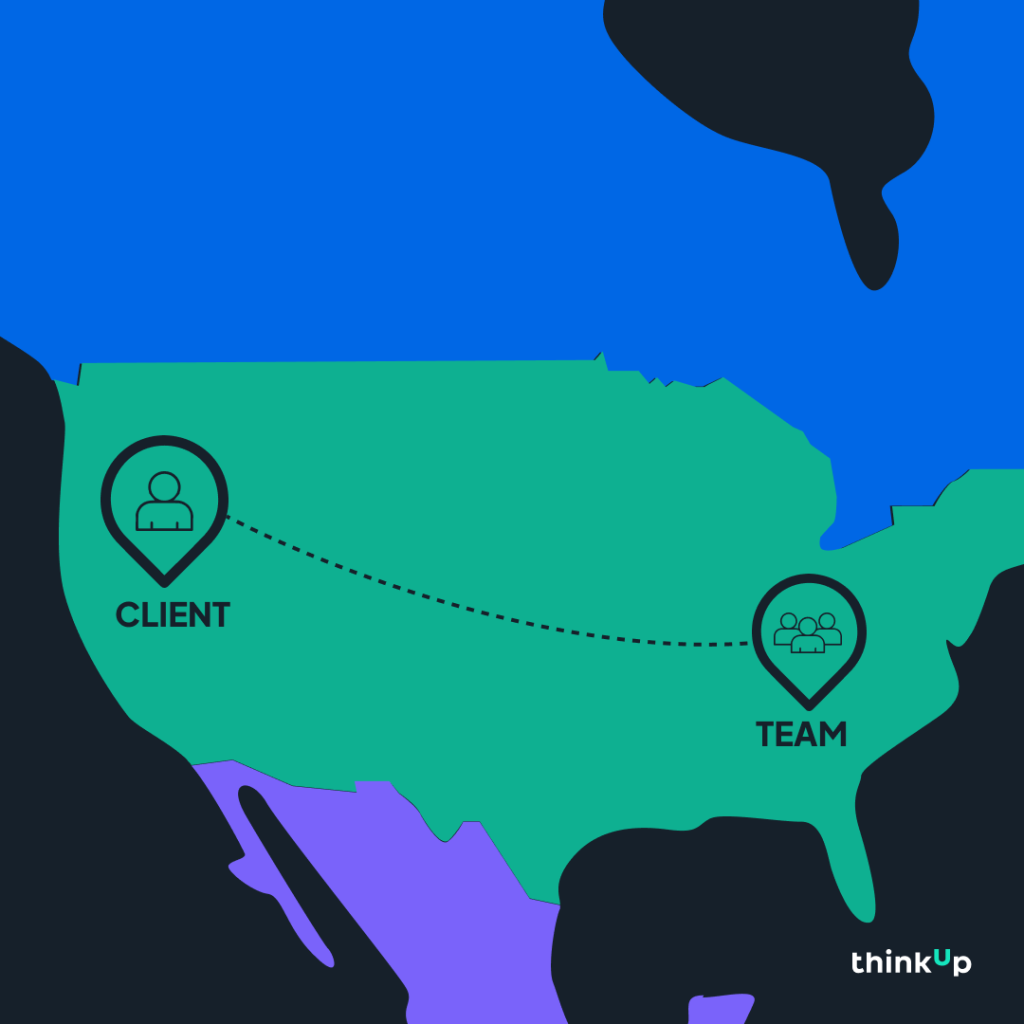
In contrast, nearshore outsourcing refers to a business engaging with a partner in geographically proximate countries, typically within a one to three-hour time difference. This model fosters closer collaboration and more accessible communication due to minor time zone discrepancies and cultural similarities.
An example of nearshore outsourcing involves a company based in one country outsourcing its projects to a nearby country. For instance, a company based in the United States outsourced its software development projects to a team located in Uruguay. This approach enables the U.S. company to maintain regular and real-time interactions with its outsourcing partner, facilitating smoother project management and quicker response times.
Both offshore and nearshore outsourcing models offer distinct advantages and can be strategically employed based on a company’s specific needs in the mobile industry. The choice between these models hinges on factors such as desired cost savings, required expertise, project management style, and the importance of close collaboration and communication in the project’s success.
By the Numbers: Key Facts and Statistics on Outsourcing
As we delve into 2024, the landscape of nearshore and outsourcing in the software development sector presents a dynamic and rapidly growing market. Let’s unpack some of the key facts and statistics that shape this industry:
1. Global: The software development outsourcing industry is expected to grow at a compound annual growth rate of 7.54% from 2023 to 2027. This growth underscores businesses’ increasing reliance on external software development services to meet their evolving needs.
2. Regional Spotlight: Outsourcing in Asia
- In the Asian market, software development outsourcing is outpacing the global average, with an anticipated annual growth rate of 9.16% from 2023 to 2027. This statistic highlights Asia as a burgeoning hub for software development services, driven by a combination of skilled labor, technological advancements, and competitive pricing.
3. Market Valuation Projections
- By 2030, the global software development and I.T. outsourcing market is expected to reach an impressive milestone, valued at $1.06 trillion. This projection indicates the significant role outsourcing plays in the global I.T. ecosystem, offering various services and solutions to businesses worldwide.
4. The United States: A Leader in I.T. Development Revenue
- In 2023, the United States became a leader in I.T. development revenue, generating over $167.90 billion. This figure reflects the country’s strong focus on innovation and its robust technology sector.
5. Global Outsourcing Service Market Size
- Currently, the global outsourcing service market is valued at $92.5 billion. This number represents the combined value of various outsourcing services, including I.T., customer service, and other business processes.
6. I.T. Outsourcing’s Dominance
- Within the broader outsourcing market, I.T. outsourcing commands a significant portion, with a valuation of $66.5 billion. This figure indicates the critical role of I.T. services in the overall outsourcing landscape, encompassing everything from software development to network management.
7. India: The Preferred Destination for Offshore Software Development
- India emerges as the number one destination for offshore software development services globally. This preference is attributed to the country’s vast pool of technical talent, cost-effectiveness, and strong emphasis on I.T. education and training.
Nearshore vs. Offshore: A Comparative Analysis with Pros and Cons
Each model offers unique advantages and challenges, influencing business strategies in distinct ways. This section aims to provide a comprehensive comparative analysis.
Pros of Offshore Software Development
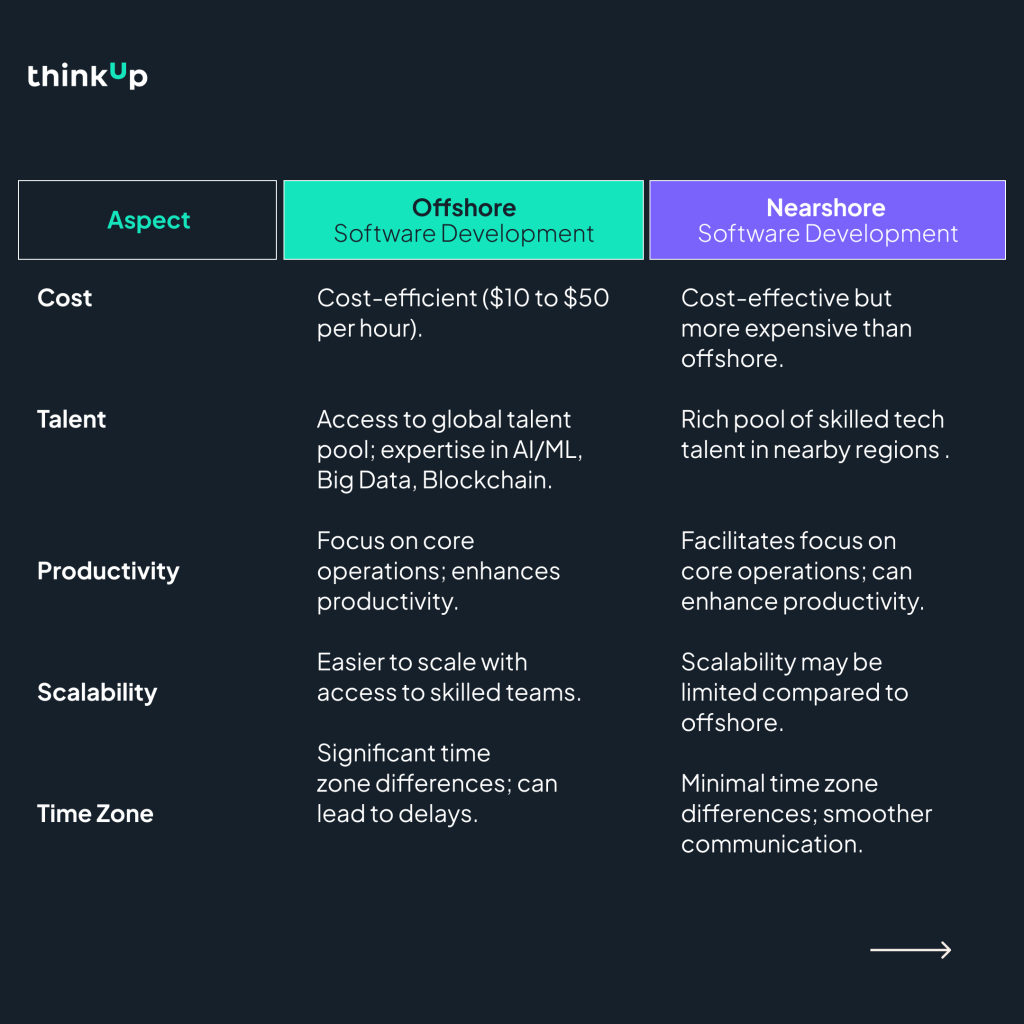
- Cost Efficiency: Offshore outsourcing offers a significant cost advantage. In developed countries like the USA, I.T. salaries are substantially higher, imposing financial burdens on companies. Offshore outsourcing offers a more affordable option, with developers in countries like India and Vietnam charging $10 to $50 per hour, compared to $60 to $200 in the USA and Western Europe.
- Highly Skilled Talent: Offshore outsourcing opens doors to a global talent pool, offering highly skilled professionals at competitive rates. Countries like India have become hubs for specialized I.T. expertise in AI/ML, Big Data, and Blockchain.
- Productivity Boost: Offshore outsourcing allows companies to focus on their core operations while delegating I.T. development to specialized partners. This not only saves costs but also enhances overall productivity and efficiency.
- Easy to Scale: Scaling I.T. operations can be challenging. Offshore outsourcing provides access to established teams with a wide range of skills, simplifying the scaling process and reducing management overheads.
Cons of Offshore Software Development
- Time Zone Difference: Significant time zone differences can hinder communication and coordination, potentially leading to delays and increased costs.
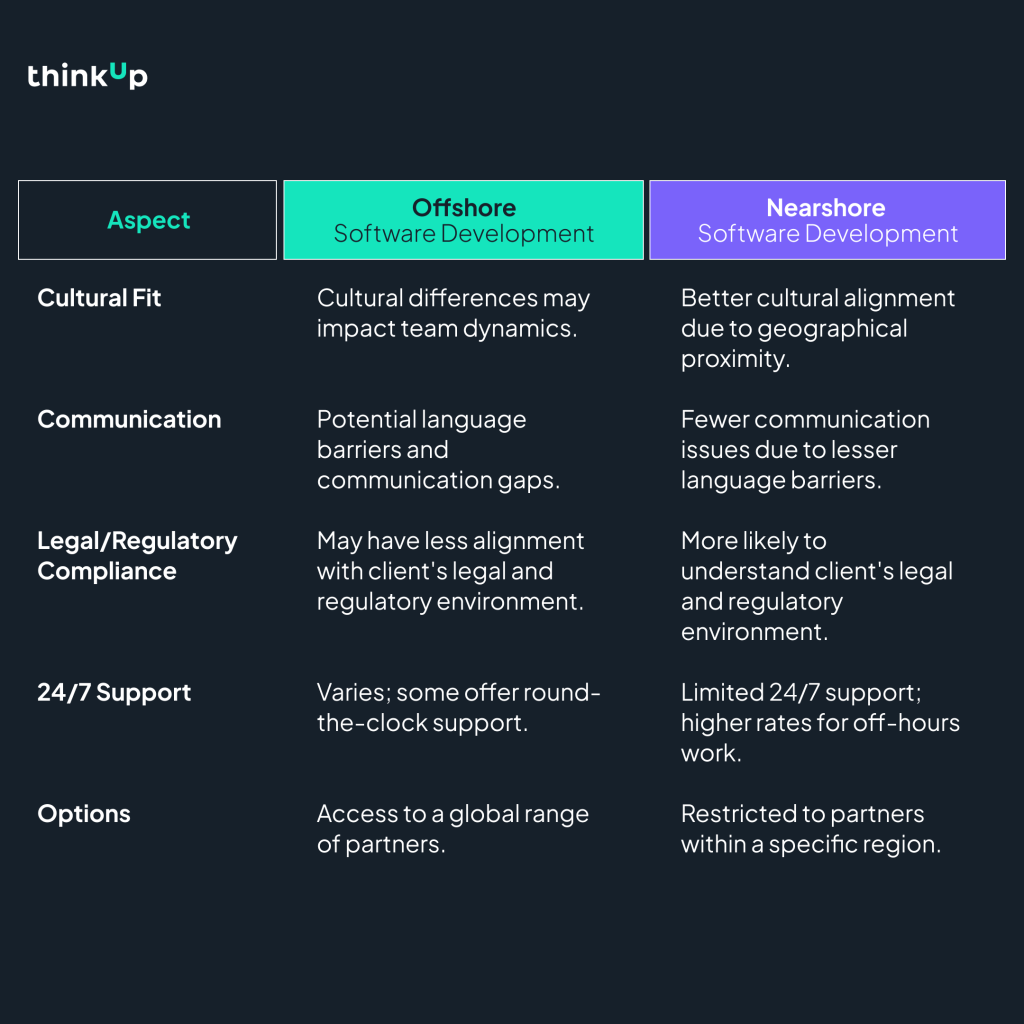
- Cultural Differences: Cultural disparities can impact team dynamics and communication. Understanding and respecting different work cultures and holidays is essential.
- Communication Issues: Language barriers and communication gaps can lead to misunderstandings, impacting project outcomes. Choosing English-speaking countries for outsourcing can mitigate this issue.
Pros of Nearshore Software Development
- Cost-Effective: While more expensive than offshore, nearshore outsourcing is still less costly than onshore options, balancing cost and convenience.
- Minor Time Zone Difference: Nearshore outsourcing offers the advantage of minimal time zone differences, facilitating smoother communication and faster turnaround times.
- Skilled Tech Talent: Nearshore regions often have a rich pool of qualified and experienced tech talent ready to tackle various I.T. projects.
- Legal and Regulatory Alignment: Nearshore companies are more likely to be familiar with their clients’ legal and regulatory environments, reducing compliance risks.
Cons of Nearshore Software Development
- Higher Costs than Offshore: Nearshore development tends to be more expensive than offshore options, impacting budget considerations.
- Limited 24/7 Support: Nearshore companies may not offer round-the-clock support and charge higher rates for working outside standard hours.
- Limited Options: Nearshore outsourcing restricts the pool of potential partners to a specific region, potentially limiting access to the global talent pool.
Frequently Asked Questions: Insights into Nearshore and Offshore Methods
This section addresses the most frequently asked questions about these two approaches, providing clarity and insights to help inform your decisions.
- What is a nearshore software development team?
A nearshore software development team is based in a neighboring country, often within the same or a nearby time zone. This arrangement saves costs and time, facilitating easier collaboration and communication due to geographical proximity and cultural similarities.
- What is an offshore software development team?
Offshore software development involves delegating work to a team in a distant region, often significantly far from your country. This method is known for being cost-effective and for providing access to a vast pool of global talent, offering a wide range of expertise and skills.
- Why is India considered the best offshore software development destination for the USA and Canada?
India is recognized as a leading destination for offshore software development for several reasons. The country is known for producing high-quality I.T. experts who offer services at competitive prices. Additionally, the widespread use of English minimizes language barriers, making collaboration smoother. These factors make India an affordable and efficient I.T. hub for developed nations.
- Is nearshore outsourcing better than offshore outsourcing?
- The choice between nearshore and offshore outsourcing depends on specific business needs and priorities. While nearshore outsourcing offers similar time zones and cultural proximity advantages, offshore outsourcing tends to be more cost-effective. It provides access to a broader global talent pool. Ultimately, the decision should be based on budget, project requirements, communication preferences, and strategic goals.
Choosing the Right Partner: Tips for Choosing Between Nearshore and Offshore
Selecting the perfect outsourcing partner for software development requires thorough research and analysis of critical factors to ensure a successful collaboration.
Here, we outline essential tips to guide you in choosing between nearshore and outsourcing development companies:
- Expertise is Paramount
- The complexity of software development varies significantly across projects. It’s crucial to partner with a company that understands your industry and target market and possesses the technical expertise specific to your project needs. Opting for a partner based solely on cost, without evaluating their expertise, can lead to increased expenses in terms of time and effort.
- Budget Considerations
- Aligning with your financial constraints is vital. Different companies offer varied pricing models for similar services. Conduct a thorough market analysis to understand standard rates and select a partner that provides the best value for your investment, balancing cost and quality.
- Evaluate Past Reviews and Client Feedback
- Authenticating a company’s credibility through past client feedback and reviews is essential. Explore review platforms like Clutch, ITFirms, Business of Apps, and DesignRush to gain insights into their service quality, delivery timelines, and project management. Directly asking the company for references can also be beneficial.
- Assess Past Work and Portfolio
- A reputable software development company will have a comprehensive portfolio showcasing a diverse clientele. Evaluate their past work, focusing on design, UI/UX, and functionality. Assessing projects similar to your requirements can provide a clearer picture of their capability to deliver quality solutions.
- Technical Skills and Resources
- Software development demands a specific set of technologies, tools, and resources. Ensure that your chosen partner has the necessary resources and a team of experts proficient in technologies relevant to your project, such as React, PHP, Ruby on Rails, or WordPress. Consider conducting interviews with the development team to gauge their expertise and knowledge.
- Customer Support and Communication
- A common challenge in nearshore and offshore development is the potential communication gap between the client and the team. Adequate customer support and transparent communication are crucial to avoid inefficiencies and delays. Assess the company’s responsiveness and inquire about its post-development support and project management systems to ensure seamless interaction throughout the project.
In summary, choosing the right software development partner requires a balanced evaluation of expertise, budget, client feedback, technical skills, and customer support. Whether you decide on nearshore or offshore outsourcing, these factors will significantly impact the quality, cost, and timeline of your software development projects.
Do you want to develop an application for your business?
At ThinkUp, we are a digital product development company, obsessed with quality and specialized in mobile applications and unique user experiences. We create world-class digital products for startups and enterprises, with the goal of transforming and empowering businesses.